The Essential
Diamond Shapes
They say diamonds are a woman’s best friend. Each diamond has its own story and it is up to you which one you will choose.
From the classic brilliant round diamond, which accounts for more than half of all diamonds sold today, to the more unusual and eccentric Marquise cut, which harkens back to the glory of the golden age.
Beyond each shape specifically catering to an individual or personal taste, each shape is meticulously and mathematically cut to bring out a diamond’s best features.

Every diamond has its own story, and every lady has her own style.
At this point, it should be noted that the shape of a diamond can also be referred to as its “cut”. However, this should not be confused with the more commonly used term diamond cut, which describes how well the diamond has been polished from the raw material (see section on diamond cut).
At ChiraNoor Diamonds we cater to each customer’s detailed wishes and want to ensure they are well informed about every diamond shape available. Our selection of diamond shapes is accompanied by detailed information, images and recommendations on uniqueness, history and background, as well as the ideal ratio of each cut.

1. Diamond Bases
| Diamond Features | Facets | L/W Ratio | Origin | Expert Tip |
|---|---|---|---|---|
| Considered to be of ideal proportions for maximum brilliance. | 57 (58 without sharp chisel) | 1.00- 1.02 | From the 17th century | The most brilliant and popular of all forms; versatile and classic. |
2. Features

The round cut is the most popular diamond shape, accounting for more than half of all diamonds sold today. Although developed in Europe, the round diamond is sometimes referred to as the American Ideal Cut.
With 57 facets split between the crown, girdle and pavilion and a typical ratio between 1.00 and 1.02, it offers maximum brilliance as the cut naturally follows the rough diamond crystal.
The round brilliant is the most researched cut in the industry; for over a century, diamond cutters have used advanced scientific theories of light reflection and precise mathematical calculations to optimise their fire and brilliance.
3. Diamond History
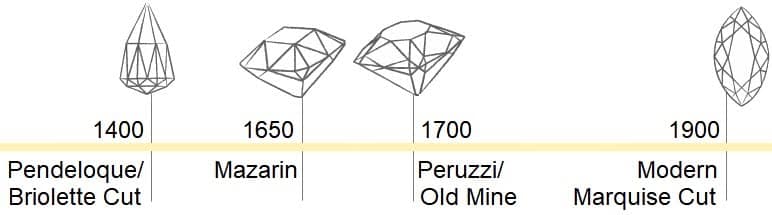
The origins of the brilliant round cut can be traced back to the mid-17th century, when an Italian cutter began using more refined and complex ways of cutting diamonds. The first brilliant cuts were known as Mazarins “Cardinal Mazarin” who made the first cross cut diamond in 1650.
Through a series of gradual transformations and developments throughout the 18th century, the Mazarins gave rise to the Portuguese Peruzzi, “old mine” or “old European cut” in the 1700s.
It was not until 1919 that the modern round diamond was created; at the time it was called the Tolkowsky cut, named after its creator, the Russian mathematician and diamond enthusiast Marcel Tolkowsky.

Princess Diamond Cut

1. Diamond Bases
Also called: MODIFIED SQUARE or RECTANGULAR BRILLIANT
| Diamond Features | Facets | Raport L/W | Origin | Expert Tip |
|---|---|---|---|---|
| The contemporary square cut, the brightest of all square shapes. | Usually 57 or 76 | 1.00 – 1.05 (square) > 1.05 (rectangular) | 1970’s, developed from barion & quadrillion cuts. | Ideal for ring watches and eternity bands. |
2. Features

Princess cut diamonds can make ideal wedding rings because they are exceptionally clear. Their lovely shape makes them a colourful treasure, as they are designed to get maximum brightness from their square cut.
When purchasing a precious princess cut diamond, make sure your ring setting captures the four sharp corners. Princess Cut precious diamonds allow all the more acceptable blemishes.
3. Diamond History
Princess cut diamonds are the second most popular diamond shape. Princess cut diamonds possess the gorgeous sparkle of brilliant round diamonds in a distinctive square shape. They offer a contemporary look and the flexibility to work in almost any ring style.
The name “Princess Cut” was originally used in connection with another diamond cut known as “Profile”, which was designed by London cutter Arpad Nagy in 1961. The same name was later used and popularised by Ygal Perlman, Betzalel Ambar, and Israel Itzkowitz in Israel, who in 1979 created the Princess cut (or Square Modified Brilliant) as it is known today.
Other precursors to the Princess cut include the Barion – a square cut with rounded corners created in 1971 by South African cutter Basil Watermeyer and the Quadrillion – a similar cut with only 49 facets, also created by Perlman, Ambar and Itzkowitz and originally distributed by Ambar Diamonds from Los Angeles. After several years of optical research, the modern princess cut was created – a square stone with 58 facets arranged similar to those of a brilliant-cut round diamond.

Cushion Diamond Cut

1. Diamond Bases
Also referred to as: PILLOW or CANDLE CUTTING
| Diamond Features | Facets | L/W Ratio | Origin | Expert Tip |
|---|---|---|---|---|
| Larger, light-dispersive facets. | Usually 57/58 | 1.00 – 1.05 (square) > 1.10 (rectangular) | 19th Century | Opt for modified brilliants with “crushed ice effect” if looking for more scintillation. |
2. Features

As the name suggests, a pillow cut is a square or rectangular shape with rounded corners that resembles a pillow. The cushion cut is typically composed of 58 facets with a typical ratio of 1.00 to 1.05 for square shapes and 1.10 or higher for the most rectangular. Although not as bright as round brights, cushion cuts have large facets, allowing for greater separation of white light into spectral colours.
The cushion cut can be described as a cross between the old mine cut and the modern oval shape. As cutting techniques and styles have evolved over the years, several variations of the cushion cut have been developed, such as the Cushion Modified Brilliant, which can have an additional row of facets on the pavilion that alters the diamond’s appearance.
3. Diamond History
The cushion cut diamond is one of the oldest cut shapes and styles and has consistently ranked high in popularity for engagement rings. Throughout the long history of the pillow, there have been many evolved variations of the cut style. The first cushion-cut diamonds date back to the early 1700s. This cut style is known as the Old Mine cut, named after its origin, the Brazilian Diamond Mines.
In that time with limited technology, it was a very difficult process to cut a diamond, so the main priority for most diamond cutters was saving time and money. Thus, many of the cut diamonds are intended to retain as much rough weight as possible.
The defining characteristics of an Old Mine cut diamond are a square shape with a high crown (top), a small mass, a deep pavilion (bottom), and a large culet.
As faceting technology continued to evolve, more precise cuts could be developed throughout the 20th century. Cushion brilliant cut diamonds are of three kinds (Cushion Brilliant,Cushion Modified Brilliant,Cushion Hybrid Brilliant. The Gemological Institute of America (GIA) has made distinctions between these three types of cushions based on the technical standard of faceting. These standards and differences should be taken into consideration and you should choose the diamond that is most aesthetically pleasing to you.

Oval Diamond Cut

1. Diamond Bases
Somewhere between ROUND DIAMOND and PEAR SHAPE
| Unique Features | Facets | L/W Ratio | Origin | Expert Tip |
|---|---|---|---|---|
| Symmetrical, elongated rounded shape. | Usually 57/58 | Typically 1.33 – 1.66 | 19th Century | Optimise carat weight and give a bigger shape to the ring. |
2. Features

The oval cut is a rounded shape, usually composed of 57/58 facets, with a typical ratio between 1.33 and 1.66.
Somewhere between the round shine and the pear shape, the oval cut is the perfect choice if you want to enjoy the shine of the round shine in a slightly more sparse and elongated shape.
A “bow tie effect” occurs when light passing through the diamond casts a shadow across the central facets of the diamond. This shadow can be reduced by changing the depth of the pavilion and adjusting the angles of the table and sides to better diffuse the light in the central area. This effect also occurs in pear, marquise and heart shapes.
3. Diamond History
Although oval-shaped diamonds were first introduced over 200 years ago, the modern oval cut was invented in the early 1960s by the Russian leader, Lazare Kaplan. The cut eventually earned him a place in the Jewelers International Hall of Fame, however, Kaplan left his mark on the diamond industry with his unique ability to split a rough diamond into smaller stones with a single blow. This process is known as splitting.
When a raw material is poorly shaped or contains defects that prevent it from being turned into a single stone, it must be split along the grain. Kaplan became famous for his expertise in taking stones that were otherwise considered unworthy and turning them into beautifully cut diamonds.

Pear Diamond Cut

1. Diamond Bases
Also called: PENDELOQUE or TEARDROP CUT
| Unique Features | Facets | L/W Ratio | Origin | Expert Tip |
|---|---|---|---|---|
| Unique shape with a single point and a rounded. | Usually 56 to 58 | 1.50 – 1.70 | 15th Century | Elongates finger, optimal colours H and above. |
2. Features

The pear shape is a unique and hybrid diamond cut that combines the brilliance and design style of both round and marquise brilliants, resulting in a single point shape with a rounded end.
The typical ratio is between 1.50 and 1.70, and the diamond is usually composed of 58 facets, although the number of flag facets can vary from 4 to 8. In addition, pear shapes are sometimes cut with a “tip French”, which replaces the large frame. facet in point with star facets and top belt. French tips are also used in heart and marquise shapes. Pear-shaped diamonds can vary in appearance, with some having what are called “high shoulders,” making the diamond appear more angular.
The pear shape can suffer from the so-called “bow tie effect” when light passing through the diamond casts a shadow over the central facets of the diamond. This shadow can be reduced by changing the depth of the pavilion and adjusting the angles of the table and sides to better diffuse the light in the central area. This effect also occurs in heart, marquise and oval shapes.
3. Diamond History
The first pear-shaped diamond was created in the 1400s by the Flemish cutter Lodewyk van Berquem of Bruges, the inventor of the diamond polishing wheel or scaife.
This invention allowed him to polish all the facets of the diamond to optimise the reflection of light inside it. From this point on, diamonds began to be used in jewellery.
Van Berquem also pioneered the now common symmetrical arrangement of facets on a diamond, this in turn led him to model the pear-shaped ‘Pendeloque’ or ‘Briolette’ cut.

Emerald Diamond Cut

1. Diamond Bases
Also called: SQUARE CUT EMERALD
| Unique Features | Facets | L/W Ratio | Origin | Expert Tip |
|---|---|---|---|---|
| Broad flat pane, truncated corners, step cut. | Usually 57, varies depending on the number of rows on the crown and pavilion. | Typically 1.30 – 1.50 (depending on taste) | Evolved from table cuts, 20th Century | Clarity VS1/VS2 and higher is optimal. |
2. Features

One of the first cuts used in jewellery, the emerald cut is a rectangular shape with truncated corners and a wide, flat plane that resembles the steps of a staircase when viewed from above. This style is referred to as a ‘step cut’. The emerald is typically composed of 57 facets (with 25 on the crown and 32 on the pavilion), although the number of rows of facets on both the crown and pavilion can vary, altering the total number of facets for this cut.
Although it usually has less fire and sparkle than brilliant cuts, the broad flat plane of this shape highlights the clarity of a diamond and its natural rectangular crystalline growth. In addition, the flat planes of the edges allow for a variety of side gem diamonds, such as the long, thin rectangular diamonds that often flank this cut, known as baguettes.
The vast majority of emerald cuts have a length to width ratio between 1.30 and 1.50, with 1.40 being considered “ideal” or the most popular. Those who prefer a more square shape will opt for smaller ratios while those after a more rectangular cut will choose higher ratios. Emerald proportions outside this range are atypical and generally less desirable.
3. Diamond History
The exact origins of the first emerald cut remain somewhat ambiguous, although its stylistic specifications can be traced back to the single table cuts of about 500 years ago and the multifaceted table cuts of the Art Deco period of the early 20th century.
The term “emerald cut” did not come into use until the Art Deco period, despite the fact that diamond cutters were already cutting the same shape under different names. Originally, the cut itself was developed specifically for emerald gemstones to reduce the pressure exerted during cutting and to protect the gemstone from chipping. However, diamond cutters soon realised the importance of this cut and applied it to diamonds as well.

Heart Diamond Cut

1. Diamond Bases
Ever the romantic choice. This is a RARE AND SYMBOLIC CUT
| Unique Features | Facets | L/W Ratio | Origin | Expert Tip |
|---|---|---|---|---|
| Exclusive heart shape design. | 56 to 58 facets | Typically 0.90 – 1.10 | 16th Century | Good symmetry is essential. |
2. Features

The heart shape is usually composed of 56 and 58 facets, although the number of main facets of the flag can vary between 6, 7 and 8. In addition, heart shapes are sometimes cut with “French tips”, which replace the large bezel facet from star point and upper belt facets. French tips are also used in marquise and pear shapes. Heart shapes may differ slightly in appearance depending on their brand or structure.
The traditional heart shape should have a ratio between 0.90 and 1.10 and be absolutely symmetrical with the lobes (upper arches) of uniform height and width, although these specifications can be changed according to personal preference.
When determining the length/width ratio for heart shapes, the width is measured at the widest point of the shape from the edge of one lobe to the other. In addition, the heart shape can suffer from a so-called “bow tie effect” when light passing through the diamond casts a shadow over the central facets of the diamond.
3. Diamond History
The exact origins of the brilliant heart are unknown, although being a modified brilliant cut, it may have originated as early as the 16th century. However, gems that would today be classified as “triangular with rounded corners” or “droplets” were at one time described as having a heart shape. Indeed, this is evident from the numerous descriptions in French inventories dating from the mid-seventeenth century.
The first recorded heart-shaped diamond appears in a portrait titled “Princess Gonzaga”, painted around 1605 by Frans Pourbus the Younger. The large jewel on the princess’s left sleeve contains a variety of different cuts, some of which are believed to be versions of the heart-like “droplets” popular in France at the time. The heart shape is also mentioned in a book written in 1655 by Jean-Baptiste Tavernier, the French travelling merchant who made his fortune in the gem trade and brought the famous Hope diamond to France. In the text, he recalls seeing the “Heart Diamond,” a 36-carat, brilliant-shaped heart in an ornament from Aurangzeb’s treasure in India.

Radiant Diamond Cut:

1. Diamond Bases
Also referred to as: SQUARE – OR RECTANGULAR MODIFIED BRILLIANT
| Unique Features | Facets | L/W Ratio | Origin | Expert Tip |
|---|---|---|---|---|
| Signature trimmed edges, brilliant step cut. | Usually 70 | 1.00 – 1.05 (square) > 1.05 – 1.50 (rectangular) | 1977 | Hides inclusions well. |
2. Features

Radiant is a unique and hybrid cut composed of 70 facets and distinctive cut edges. Square-shaped radiants typically have ratios between 1.00 and 1.05, while rectangular radiants can have ratios from over 1.05 anywhere to 1.50.
Its versatile design combines the sparkle and depth of round, emerald and princess cuts, making it a popular choice for all types of jewellery.
Since it is a proprietary cut, it may refer to a square with corners cut in a laboratory certificate (eg. GIA or AGS), or a rectangular Brilliant if it has a ratio greater than 1.05.
3. Diamond History
The first Radiant cut was designed by Henry Grossbard of the Radiant Cut Diamond Company (RCDC) in 1977. Prior to this invention, all diamonds with square or step cut edges appeared less brilliant.
Grossbard invented a hybrid cutting style that revolutionised the industry’s perceptions towards square or rectangular diamonds as he managed to create a step cut diamond that possessed equal brilliance to triangular faceted diamonds such as the oval and pear.
The Radiant is also the first cut to have a brilliant-facet pattern applied to both the crown & pavilion. RCDC launched the Original Radiant Cut diamond brand in 2002.

Asscher Cut Diamond

1. Diamond Bases
Also referred to as: SQUARE EMERALD CUT
| Unique Features | Facets | L/W Ratio | Origin | Expert Tip |
|---|---|---|---|---|
| Brightest step cut, “hall of mirrors” effect. | 50 or 57 (Royal Asscher has 74) | 1.00 – 1.05 | Art-deco era, early 20th Century | Clarity VS1/VS2 and higher is optimal. |
2. Features
The asscher cut has a unique shape with prismatic brilliance and a rectangular faceted pavilion in the same style as the emerald cut. The standard number of principal facets on an Asscher cut is usually 58, and the typical ratio for the more popular square-shaped Asscher cuts is 1.00 to 1.05.
The width of the cut corners may vary. Full of timeless elegance and Art-Deco cool, the asscher cut has a rectangular shape similar to the most famous emerald cut, with a prismatic lustre, with its deep pavilion, faceted bezel, high crown and small table, the asscher cut allows for stunning lustre and creates a fascinating optical illusion known as the “Hall of Mirrors” effect.
The Asscher cut is referred to as the square emerald cut on a laboratory certificate such as GIA or AGS. Although confusion reigns as to what the differences are between an asscher cut and a square emerald cut, they are actually the same thing. However, there is also a much rarer Royal Asscher cut, which is a patented version of the original Asscher cut with wide cut corners and 74 facets (instead of 58) and is classified as an octagonal cut by the GIA.
3. Diamond History
Named after its creator Joseph Asscher, owner of the diamond company of the same name in Amsterdam, the Asscher cut was developed in the early 20th century at the birth of the stylish and popular Art Deco movement. Joseph Asscher became famous a few years later when he was commissioned by King Edward VII to cut the famous 3,106 carat Cullinan diamond for the English Crown Jewels. In 1980, Her Majesty Queen Juliana of the Netherlands granted the Asscher Diamond Company a royal title in recognition of the role the Asscher family and company had in the diamond industry.
The popularity of this cut peaked in the late 1920s, but it remained a somewhat rare commodity for the remainder of the century, available only in antique shops and Art-Deco specialty jewellers. At the turn of the new millennium, following considerable research and development, the Asscher cut was redesigned with new specifications and additional facets for a brighter shine and has since regained its popularity.

Marquise Diamond Cut:

1. Diamond Bases
Also referred to as: NAVETTE SHAPE
| Unique Features | Facets | L/W Ratio | Origin | Expert Tip |
|---|---|---|---|---|
| Long “ navette” oval shape. | Usually 56 to 58 | Ideally 1.85 – 2.10 | 1745 French Royalty. | Optimises carat weight and elongates fingers. |
2. Features

The marquise brilliant cut can also be referred to as the ‘Navette’ shape, meaning ‘small boat’, as the shape of the diamond is said to mirror the hull of a small boat. It generally consists of 58 facets, with 33 on the crown and 25 on the pavilion, although the number of facets in the pavilion can vary between 4 and 8. In addition, marquise shapes are sometimes cut with a “French tip”, which replace the big one. bezel facet to star faceted point and top belt.
French tips are also used in heart and pear shapes. Even though the Marquisa’s optimal ratio is 2.10, the shape is more traditionally cut to ratios between 1.85 and 2.10, depending on personal preference.
Marquises can suffer from a so-called “bow tie effect” when light passing through the diamond casts a shadow over the central facets of the diamond. This shadow can be reduced by changing the depth of the pavilion and adjusting the angles of the table and sides to better diffuse the light in the central area. This effect also occurs in pear, oval and heart shapes.
3. Diamond History
The Marquise cut first appeared in Paris around 1745, and its fascinating history can be traced back to the height of the French monarchy. King Louis XV commissioned his court jeweller to create a diamond to resemble the smile of his beautiful mistress, Marchioness Madame de Pompadour. A well-educated and intellectual woman who exerted strong political views on the French court, Madame de Pompadour was official maitresse en titre to King Louis XV from 1745 to 1750.
The shape was then developed and modified throughout the 20th century, evolving into the brilliant marquise cut as it is known today, seeing a particular rise in popularity between the 1960s and 1980s. The marquise cut first appeared in Paris in circa 1745. The fascinating history of the marquise cut can be traced back to the height of the reign of the French monarchy.